




High-level results
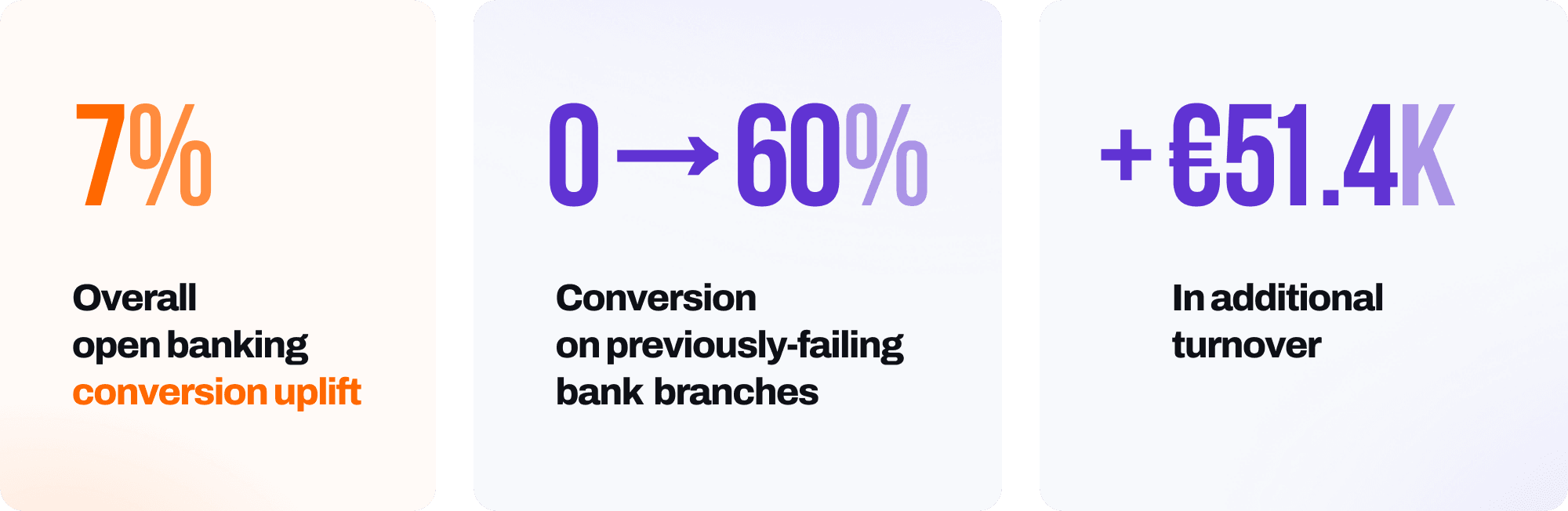
- +7% increase in overall payment acceptance
- 0% to 60%+ acceptance uplift on previously failing bank branches
- +€51,400 in additional merchant turnover over two weeks.
The challenge: strong traffic, but uneven payment acceptance
A high-volume iGaming merchant had experience with open banking and historically processed payments through a direct merchant's IBAN setup across multiple EU markets. But acceptance was unsatisfactory – across several countries and banks, the merchant was seeing inconsistent conversion. Some routes worked well, while others failed repeatedly. In certain bank branches, for example, Sparkasse and Volksbanken Raiffeisenbanken in Germany, acceptance was effectively 0%.
For an iGaming business where deposit success directly affects revenue, even small acceptance rate differences have a visible commercial impact. This is why the merchant began routing less volume through the open banking channel in favour of card payments and started questioning the method itself.
However, the real problem was not open banking, but something more specific – and entirely fixable.
What Noda did: tested Noda IBAN and optimised routing by bank performance
For Noda, this was exactly the kind of complex payment challenge where deeper analysis could make a measurable difference – so our team started by examining the merchant’s setup at route level.
Opened a Noda IBAN for the merchant
We started by moving part of the merchant’s traffic from the existing direct IBAN setup to a Noda-provided IBAN as part of a performance test.
The goal was to understand whether the merchant could achieve better acceptance by changing the payment setup, certificate, receiving IBAN and Payment Initiation Service (PIS) route used for specific traffic segments.
Mapped conversion at the bank branch level
Once the Noda-provided IBAN was live, we analysed performance at a more granular level. Instead of only looking at total conversion, our team reviewed how different bank routes were performing.
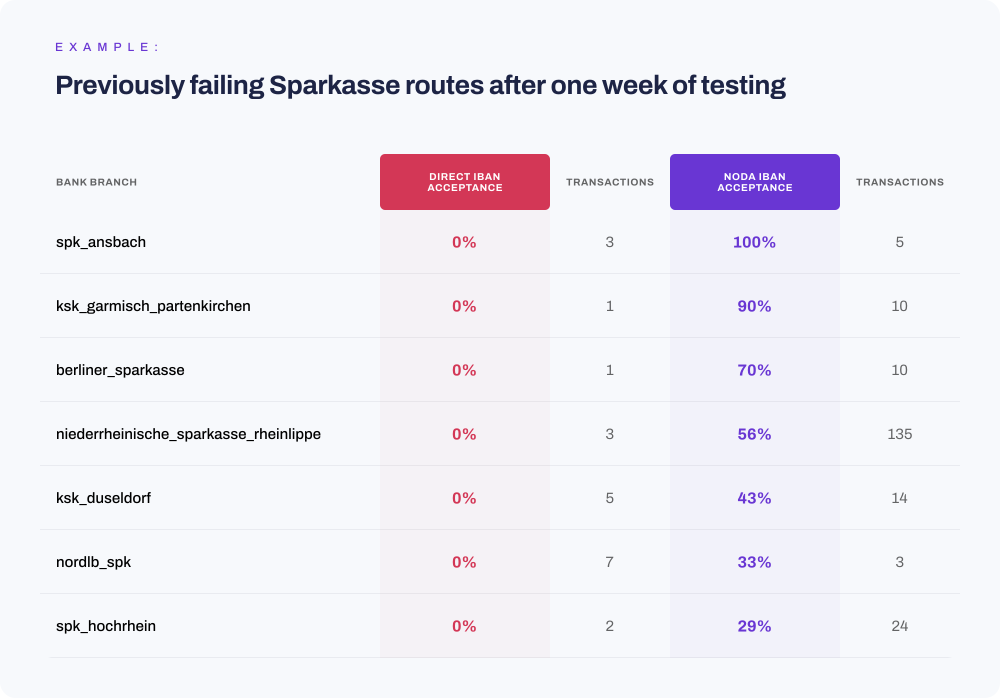
That analysis showed an important pattern – some bank routes that were failing through the previous setup could perform significantly better when routed through Noda’s direct connections and one of Noda’s PIS partners.
In some cases, routes that had previously produced 0% acceptance began reaching 60%+ acceptance after the setup was adjusted.
Routed failing branches through Noda-provided PIS layer
Our analysis indicated that the root cause of some of the branch-level failures was an entity mismatch: the payment was initiated by one entity but received by another. The fix was to route those specific branches through Noda-provided PIS infrastructure – where both the initiation and the IBAN receipt belong to the same entity.
Expanded Noda IBAN as the preferred route
After the test showed stronger acceptance on previously failing routes, Noda expanded the routing logic and began sending the majority of the merchant's open banking traffic through Noda-provided IBAN.
Other bank routes remained available as fallback, but Noda-provided IBAN became the preferred route for stronger acceptance.
The same-entity advantage, explained
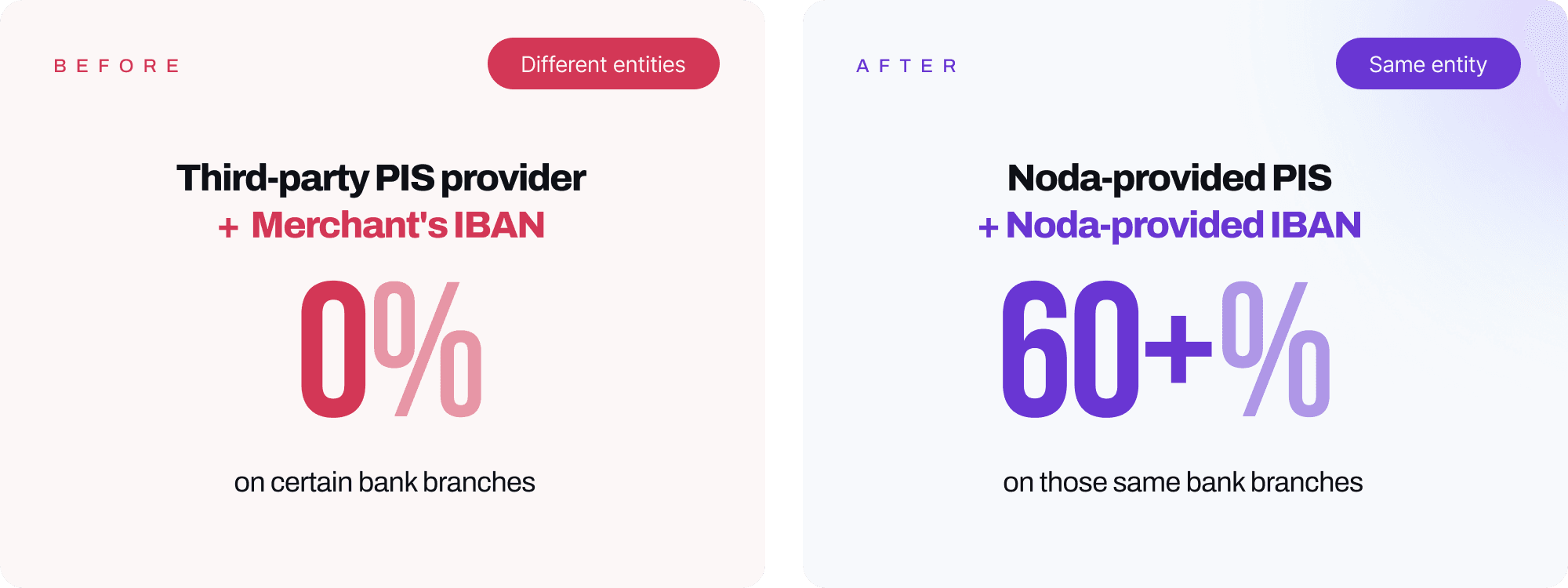
When a customer pays via open banking, two parties are involved: the Payment Initiation Service (PIS) provider, who triggers the transfer from the customer's bank, and the IBAN recipient, who receives the funds. In most standard setups, these are different companies.
For the majority of banks, this works fine. But, as our tests have shown, certain branches, particularly those with stricter internal verification logic, handle the cross-entity combination inconsistently. They see an initiation from Company A going to Company B, and the transaction doesn't pass cleanly.
Noda's infrastructure includes a partner PIS capability alongside IBAN issuance – both from the same entity. By routing the failing branches through Noda-provided PIS layer, both sides of the transaction became internally consistent. Banks that had been systematically declining transactions started approving them.
The result: 7% overall conversion uplift
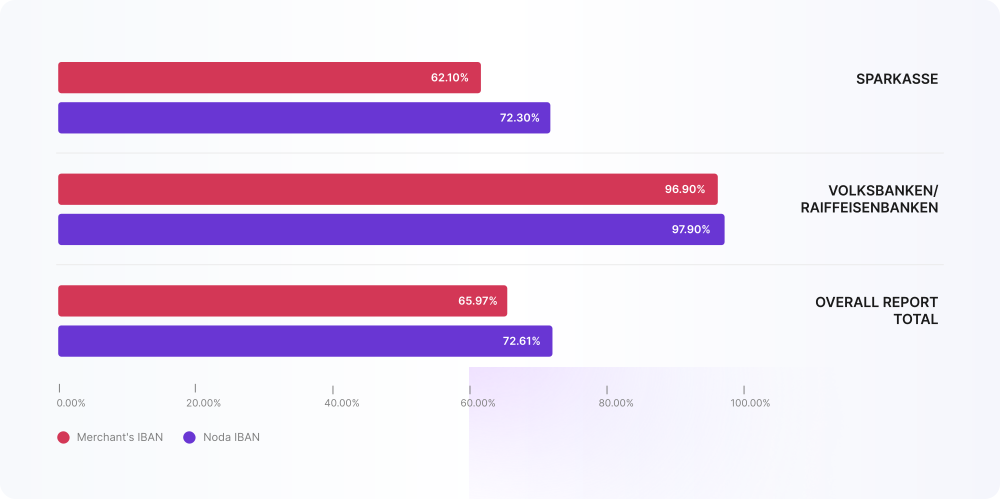
After the routing changes, the merchant saw a 7% increase in overall conversion.
That uplift is especially meaningful because the strongest improvements came from specific underperforming routes, not from every transaction equally.
Some bank routes that previously had 0% acceptance reached 60%+ acceptance after being moved to a better-performing setup. These routes represented only part of the merchant’s total traffic, so the total conversion uplift landed at 7%.
In this case, the uplift represented approximately €51,400 in additional merchant deposit volume over the two weeks after changes.
The bigger lesson: infrastructure depth is what separates good open banking from great open banking
Open banking payments are not one uniform flow. Acceptance can vary depending on the bank, the country, certificates, the receiving IBAN, the payment journey configuration and many other factors. Two providers can deliver very different results on exactly the same traffic – and finding out why often requires time, granular analysis and infrastructure-level expertise.
This is the kind of problem our team genuinely enjoys solving. It required real infrastructure depth, granular analysis and a willingness to go further than a standard integration. The result was measurable and fast.
We're proud of it – but we're still at it. We continue ongoing work with this merchant on their checkout UX analysis and payment button optimisation to push conversion even further.

Read More Case Studies

How one travel company took the stress out of travel booking for its customers

Streamlining Payments for WoM2 with Open Banking and MoR Solutions